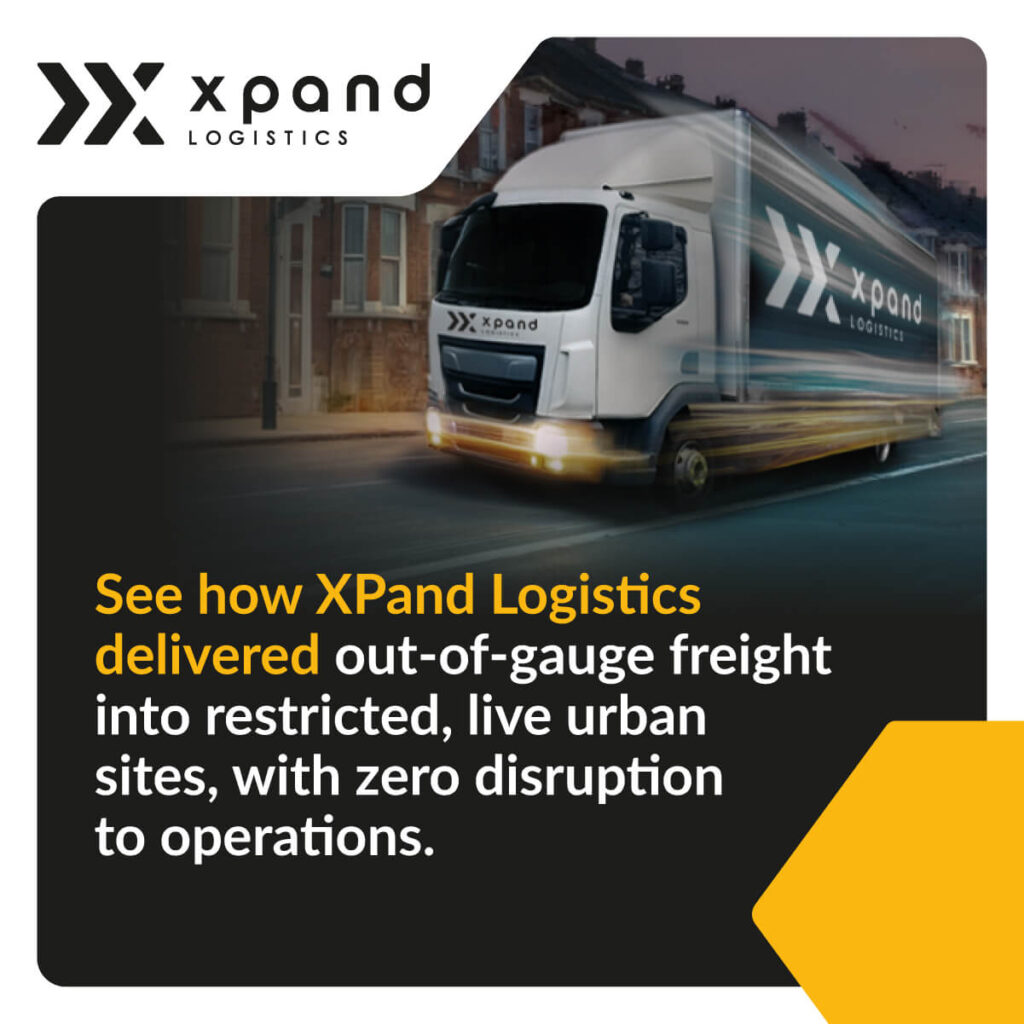
Warehousing, preparing and coordinating the delivery of multiple oversized freight units into live, access-restricted urban sites
Client: Confidential infrastructure and specialist equipment client
XPand Logistics was appointed to manage the storage, preparation, sequencing and final-mile delivery of multiple oversized freight units for installation into a series of live, access-restricted urban sites. The freight was heavy and non-standard in profile, meaning it could not be processed through standard palletised freight networks or delivered using routine final-mile methods.
The Challenge
Each unit was oversized and comfortably exceeded standard handling weights, making conventional delivery approaches impractical. The receiving sites operated around the clock, so there was no downtime window in which deliveries could be scheduled without careful planning. Sites were characterised by:
- Narrow entrances and limited yard space, with tight turning circles
- Continuous operational activity that could not be disrupted
- Height restrictions and nearby parking or traffic controls in dense urban areas
- Shared circulation routes used simultaneously by other business critical operational vehicles
- Installation engineers whose schedules did not always align with delivery windows
- Limited availability of mechanical handling equipment at site level
- Risk of delay if goods arrived before a site was ready to receive them
The freight itself also called for non-standard handling. Standard pallet-network or curtain-sided delivery processes were not appropriate given the dimensional limitations, load stability requirements and the need for controlled positioning at the point of delivery. With multiple sites to deliver to against a tight operational programme, the client needed a logistics partner with the expertise, flexibility and meticulous planning capability to make it work without a single hiccup to live operations.
The Approach
XPand Logistics took full ownership of the logistics challenge, beginning with thorough preparation before a single unit left the warehouse.
Each unit’s outer casing was removed at our warehouse prior to dispatch, to reduce both the weight and the physical dimensions of each unit: a practical step that made handling and urban delivery significantly more manageable without compromising the equipment itself.
Our team deployed 7.5-tonne trucks equipped with tail lifts and a two-person crew for every delivery run. Because each unit was on a pallet base, it could be manoeuvred efficiently using pallet trucks once on the ground, an important consideration for sites where space for handling equipment was at a premium.
A structured, phased delivery schedule was designed around the geography of the sites, with deliveries grouped by proximity to minimise transit time and maximise efficiency. Prior to every delivery, each site was individually surveyed and assessed for vehicle access and turning capability, safe and viable unloading areas that would not obstruct live operations, and any height restrictions, road controls or environmental constraints.
Close, ongoing coordination with the client’s project manager and individual site managers was central to our approach. Delivery slots were booked in advance and confirmed against installation engineer availability. Where engineers were not yet on-site at the point of delivery, we worked with site managers to agree a safe, secure temporary drop-off location, ensuring equipment was never left in a position that could interfere with day-to-day operations.
Delivery Methodology
1. Warehouse Intake and Freight Assessment
Each consignment was assessed before despatch, including gross weight, dimensions, packaging format, load integrity, lifting points and any requirement for specialist handling equipment.
2. Site-Specific Delivery Planning
Delivery planning was completed on a site-by-site basis rather than applying a single standard transport model. Each location was reviewed for access restrictions, unloading options, temporary holding areas, traffic controls and coordination requirements with on-site installation teams.
3. Vehicle Selection and Load Sequencing
Vehicle selection was based on freight profile, site access and unloading methodology, with consideration given to tail-lift suitability, load restraint requirements, vehicle length, turning capability and kerbside access. Loads were sequenced to match the delivery route and the order in which units needed to come off the vehicle, reducing unnecessary handling and limiting time on site.
4. Stakeholder Coordination
Deliveries were scheduled in phases to align warehouse release with site readiness. XPand maintained direct communication with client representatives, site contacts and installation teams before and during each delivery to confirm access, readiness and handover requirements.
5. Operational Contingency Management
Where site conditions changed, the delivery plan was adapted in real time. If an engineer’s schedule moved or a site was not yet ready for installation, XPand worked with the site contact to agree a safe drop location that protected the freight, avoided obstruction and maintained site access.
Risk Management Strategy
A structured risk management approach was applied throughout the project to identify, assess and control potential issues before freight arrived on site. Key risks included restricted vehicle access, insufficient unloading space, load instability, manual handling constraints, interface with pedestrians or live site activity, weather conditions and delays caused by limited urban delivery windows.
Mitigation measures included advance access reviews, route and turning assessments, suitability checks for vehicle type and handling equipment, confirmation of site contact availability, pre-agreed delivery slots and clear escalation points for any access or unloading issues. Contingency planning was built into the delivery programme throughout, with alternative waiting areas, revised delivery sequences and direct communication channels with site teams helping maintain control whenever access was delayed or installation activity had to be rescheduled.
The Results
XPand Logistics successfully completed the full delivery programme, achieving the following outcomes:
- Every oversized unit delivered successfully across all sites in the programme
- Zero disruption to live, continuous site operations throughout the project
- All deliveries completed on schedule, meeting the project programme requirements
- Site surveys conducted ahead of every delivery, eliminating access issues on the day
- Flexible, problem-solving approach maintained throughout
- Access risks identified and controlled before delivery, rather than managed reactively on site
The result was a seamless rollout that kept the client’s programme firmly on track: delivered safely, efficiently, and with full regard for the critical, always-on nature of the operational environment.
Next Steps
With the initial delivery programme successfully completed, the client now has the infrastructure in place to progress the next phases of its rollout. The experience, planning discipline and collaborative approach applied throughout this project position XPand as a trusted logistics partner for future phases, as well as for other clients with similar oversized freight and restricted-access requirements.
Conclusion Section
XPand Logistics is a logistics specialist focused on complex freight and time-sensitive delivery. Our expertise lies in seamlessly navigating customs requirements, multimodal transport planning and challenging destinations, to ensure that specialist equipment and components arrive where and when they are needed. With a trusted partner network and always-on support, XPand Logistics delivers more than just freight – we deliver confidence.