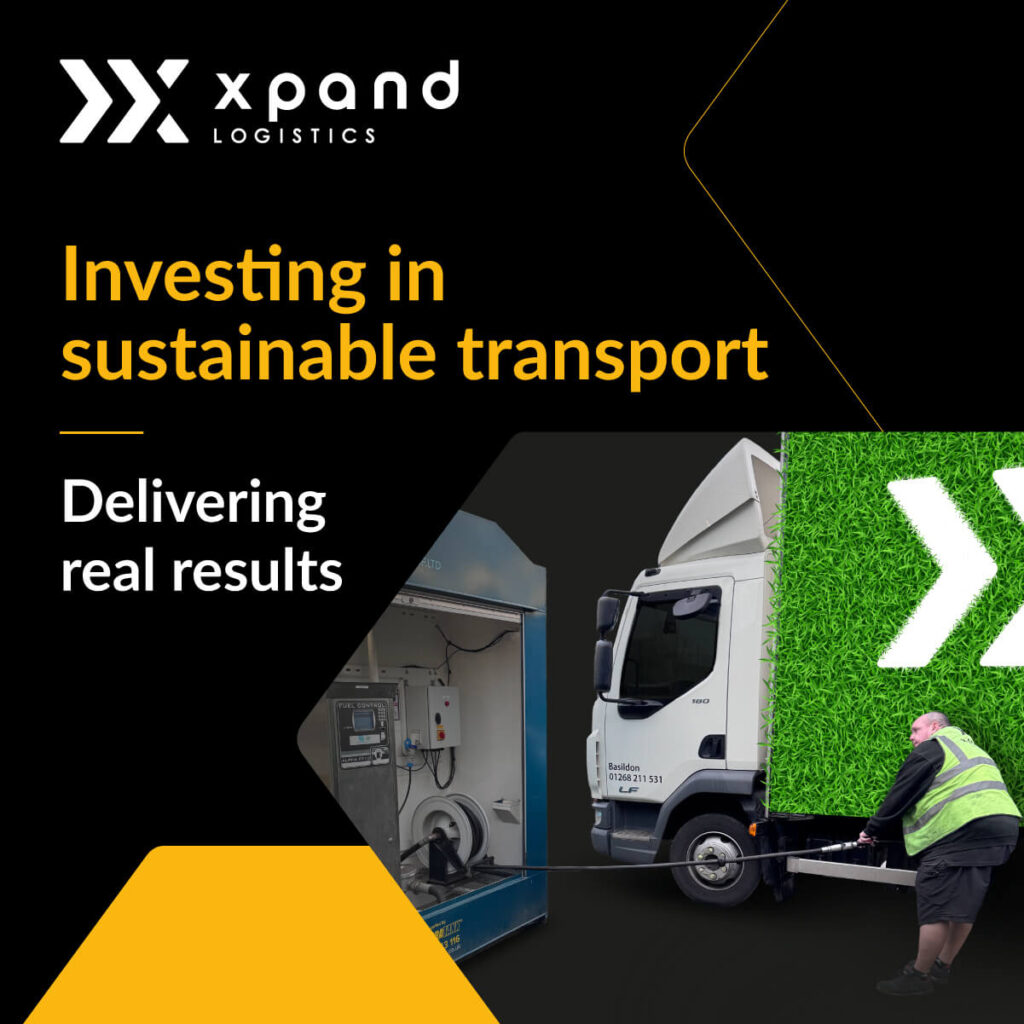
At XPand Logistics, sustainability is driven by measurable results. Following the introduction of Hydrotreated Vegetable Oil (HVO) across our 9-vehicle fleet, we analysed fuel usage and emissions to quantify its impact.
Measurable Carbon Reduction Across Our Fleet
The Comparison Period
To ensure a fair comparison, we measured:
- Baseline diesel usage: July–December 2025 (6-month average)
- HVO usage period: January–February 2026 (first 6 weeks of implementation)
Fleet Fuel Usage
Baseline (Diesel Average): 661.75 litres per week (fleet total)
After HVO Introduction: 275.76 litres per week (fleet total)
Emissions Calculations
Using the UK DEFRA diesel emission factor of 2.68 kg CO₂e per litre:
Baseline emissions: 661.75 × 2.68 = 1,774 kg CO₂e per week
HVO period comparison: 275.76 × 2.68 = 739 kg CO₂e per week
The Result
XPand Logistics achieved an estimated reduction of:
Approx. 1,035 kg CO₂e saved per week
≈ 1.04 tonnes CO₂e reduction per week
To quantify this in real-world terms, this weekly saving is equivalent to:
- ~5,800 miles driven by an average UK petrol car
- Roughly:
- Manchester to London and back ~11 times
- Manchester to Edinburgh and back ~5 times
- Over 230 average school-run round trips
In terms of everyday energy use, this saving also equates to approximately:
- ~120,000 smartphone charges
- ~3,500 kettle boils per day over a full year
Overall, weekly fleet emissions fell from approximately 1,774 kg to 739 kg CO₂e, representing a ~58% reduction within the first six weeks.
This represents a substantial reduction in fleet-related emissions within just six weeks of implementation. This reduction was achieved without vehicle modification, operational downtime, or infrastructure changes.
Estimated calculations based on UK DEFRA diesel emission factors (2.68 kg CO₂e per litre). Full comparative reporting over a longer period will be published once additional operational data is available.
What This Means
The results demonstrate that immediate carbon reduction in commercial fleets is achievable using existing vehicles. HVO provides a scalable, measurable pathway to lower emissions while maintaining operational performance.
XPand Logistics continues to monitor fuel usage and emissions data to support long-term sustainability reporting and client ESG requirements. The transition to HVO has already delivered a substantial reduction in fleet-related emissions without disrupting operations.
The Added Advantage: Cost Stability in a Volatile Fuel Market
While the environmental benefits of HVO are well established, there is also an important commercial advantage: cost stability.
In light of the recent surge in global oil prices, many logistics providers are facing increasing fuel costs. This volatility is already being passed on to customers, with a growing number of carriers introducing or raising fuel surcharges to offset rising diesel prices.
HVO offers a more stable alternative. Because it is not directly tied to crude oil markets in the same way as traditional diesel, it is less exposed to short-term price fluctuations.
For XPand Logistics, this means:
- No reactive fuel surcharges driven by oil price spikes
- Greater cost predictability for both our operations and our customers
- A more resilient and future-focused fuel strategy
Why HVO Is Gaining Popularity in UK Logistics
For logistics providers, full fleet electrification is not always immediately viable. HVO offers:
- Up to 90% lifecycle carbon reduction
- Lower particulate matter (PM) emissions
- Reduced nitrogen oxide (NOx) output
- Reliable cold-weather performance
- No vehicle or infrastructure changes required
Because it is a drop-in replacement, HVO enables immediate decarbonisation without operational disruption.
Lower Emissions. Stable Costs. Start Today.
Reach out today to learn how our HVO-powered fleet can deliver immediate sustainability results, without unexpected fuel surcharges.